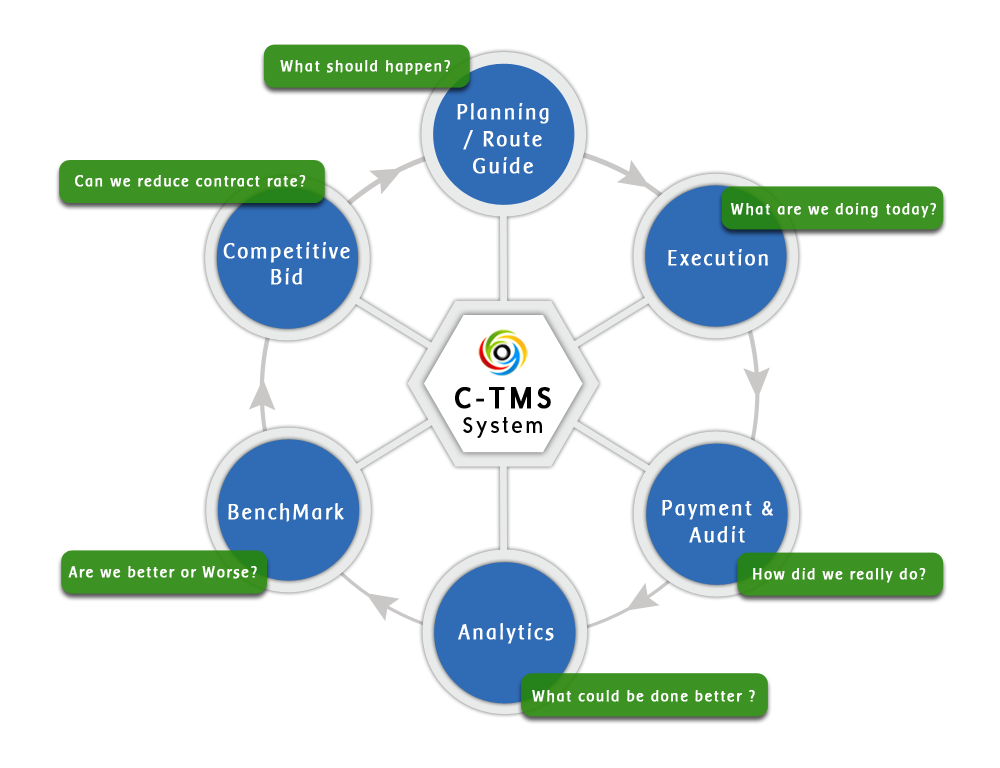
The term “CargoNet” is evolving in the marketplace to fit an ever-increasing range of software functionality and purpose. CargoNet is always expected to improve the Shippers ‘capabilities to Plan, Execute, Analyze, Benchmark and continuously improve the Management of product flow. As the ranks of Global Corporations with world-spanning supply chains are joined by more large and medium businesses with less attenuated—but no less important—lines of supply, the capabilities and focus of tools designed for the logistics function are changing to meet new demands.
A proliferation of new and competitive solutions for Transportation Management guarantees that shippers and third-party logistics companies will have more choices in feature mix, hosting mode and price point than ever before, but finding an ideal fit for complex and Distributed Transportation Management processes from among so many candidates will remain challenging.
At the highest level, the corporate logistics function responsible for moving goods through supply chain and distribution channels encompasses five major business processes
One of the most Challenging segments of freight movement domestically continues to be over-the-road trucking, which accounts for 80% of freight transportation modes. C-TMS that could open a window of business visibility and control Truck Transportation would put unprecedented cost and servicemanagement tools in the hands of shippers and 3PLs
In the commercial freight sector, one company has established a dominant technology practice focused on improving operational efficiencies, stripping out waste and reducing costs through automation and integration, while bringing increased visibility to key performance indicators and shipment status as well as daily exception monitoring. This technology has been successfully integrated with motor carrier operations for many years.
Historically operating with the slimmest of margins—motor carriers average operating margins of 5-6%– trucking companies have also been forced to seek out more sophisticated management software and technology capabilities to satisfy the needs of their shipping customers for greater visibility and more efficient business transactions, as well as their own needs to oversee complex and distributed service operations. The margins for error in making profitable transportation decisions are even narrower for asset-based firms than for shippers themselves.
The flow of product orders from the core ERP system into the transportation management process to be planned for shipment, including consolidated orders and optimal mode selection. The accurate capture of tariffs and contract details is vital to effective planning.
The process of evaluating, selecting, assigning, tendering, and dispatching shipments with transportation providers, including the private fleet. Automate to help ensure organizational compliance, but support ad hoc shipments with best rate/best carrier selection assistance. Active carrier qualification processes are critical to reducing business liability.
Capturing the flow of information for tenders, rating, shipment status, exception alerts and billing with transportation providers to drive KPIs and settlement reconciliation.